
Integration, AI, Epic, Big Health System, Monitoring
CUSTOMER SUCCESS STORY: How Guthrie Proactively Manages More Than 15 Million Daily Integration Transactions with Tido Connect™ and Tido MIDR-AI™
June 18, 2026
Transforming Integration Operations from Reactive Support to Proactive Management
Executive Summary
Healthcare organizations depend on thousands of integration touchpoints to support patient care, revenue cycle operations, clinical workflows, and business operations.
For Guthrie, an integrated healthcare system serving communities across Pennsylvania and New York, maintaining reliability across a rapidly growing integration ecosystem required a new approach.
Guthrie partnered with Tido to establish a proactive integration operating model built on Tido Connect™ and Tido MIDR-AI™.
Today, Tido proactively manages and supports an environment processing:
15+ Million Messages Daily
150,000+ Files Daily
Across:
- Epic EHR
- HL7 Interfaces
- FHIR APIs
- X12 Transactions
- EDI Exchanges
- Imaging Integrations
- File-Based Workflows
- Multiple Integration Engines
The result is a scalable, highly visible, and operationally resilient integration environment designed to support patient care, organizational growth, and long-term cost efficiency.
At a Glance
15M+
Messages Processed Daily
150K+
Files Processed Daily
24/7
Proactive Monitoring & Support
99.99%+
Interface Uptime Target
Epic
Enterprise EHR Platform
HL7 • FHIR • X12 • EDI • Imaging • Files
Enterprise Integration Coverage
About Guthrie
Guthrie is a leading integrated healthcare system providing care across hospitals, clinics, physician practices, and outpatient facilities throughout Pennsylvania and New York.
Like many health systems, Guthrie relies on a complex integration ecosystem that enables critical information to move seamlessly between clinical, operational, financial, and business systems.
As the organization continued to grow and modernize, maintaining visibility, reliability, and operational efficiency across that ecosystem became increasingly important.
The Challenge
Modern healthcare organizations face growing integration complexity.
Every day, critical workflows depend on thousands of real-time and batch transactions flowing between applications, providers, partners, payers, and clinical systems.
For Guthrie, the environment included:
✓ Epic EHR
✓ HL7 Interfaces
✓ FHIR APIs
✓ X12 Transactions
✓ EDI Workflows
✓ Imaging Systems
✓ File Transfers
✓ Multiple Integration Engines
Collectively processing:
15+ Million Messages Every Day
150,000+ Files Every Day
The challenge was not simply supporting integrations.
The challenge was creating an operational model capable of proactively managing risk, identifying issues before they impacted users, and supporting future growth without continually increasing operational burden.
Guthrie wanted to:
- Improve visibility across the integration environment
- Reduce operational risk
- Detect issues earlier
- Accelerate incident response
- Improve reliability
- Reduce dependency on reactive troubleshooting
- Create a scalable support model
- Identify opportunities for long-term cost savings
The Tido Difference
Rather than starting with technology, Tido started by listening.
Guthrie's leadership team outlined a clear objective:
Build a proactive integration organization capable of supporting enterprise growth while minimizing operational risk and improving operational efficiency.
To achieve that goal, Tido implemented a proven framework that combines managed integration operations, AI-powered monitoring, governance, optimization, and healthcare-specific expertise.
Unlike traditional staffing models or generic managed service providers, Tido delivers:
✓ Dedicated healthcare integration expertise since 2007
✓ Epic Bridges-certified resources
✓ Deep experience across HL7, FHIR, X12, EDI, APIs, imaging, and file-based integrations
✓ AI-powered proactive monitoring through Tido MIDR-AI™
✓ Managed integration operations through Tido Connect™
✓ Proven methodologies for stabilization, optimization, and modernization
Solution Overview
Tido Connect™
Tido Connect™ provides a managed integration operating model that combines healthcare integration expertise, governance, optimization, project delivery support, and operational management across the enterprise integration landscape.
Tido functions as an extension of the internal IT organization, providing strategic guidance, operational support, project execution, and continuous improvement initiatives.
Tido MIDR-AI™
Included within Tido Connect™, Tido MIDR-AI™ continuously monitors interfaces and connected applications to identify abnormal patterns, delays, queue growth, failures, and performance risks before they become operational disruptions.
Unlike traditional monitoring solutions that primarily alert after failures occur, MIDR-AI™ learns operational patterns and proactively identifies potential issues before clinicians, business users, or support teams experience impact.
Phase 1
Assess and Stabilize
Tido conducted a comprehensive assessment of Guthrie's integration ecosystem to identify opportunities for improvement across people, processes, technology, governance, and operational workflows.
Key focus areas included:
- Monitoring and alerting
- Documentation and visibility
- Operational processes
- Technical debt reduction
- Governance improvements
- Cost optimization opportunities
- Integration architecture strategy
Following the assessment, Tido worked closely with Guthrie to strengthen the operational foundation through cleanup initiatives, standardization, process improvements, and enhanced visibility.
Outcome
A more stable, manageable, and scalable integration environment prepared for proactive operations.
Phase 2
Implement Proactive Monitoring
Once the environment was stabilized, Tido deployed MIDR-AI™ across the integration ecosystem.
Continuous Monitoring Coverage
- HL7 Interfaces
- FHIR APIs
- X12 Transactions
- EDI Workflows
- Imaging Integrations
- File Transfers
- Integration Engines
- Connected Applications
MIDR-AI™ continuously analyzes activity to identify:
✓ Queue Backlogs
✓ Processing Delays
✓ Throughput Degradation
✓ Traffic Anomalies
✓ Failed Transactions
✓ Performance Risks
✓ Interface Outages
This allows Tido's team to investigate and resolve issues before they impact patient care, operations, or revenue cycle workflows.
Phase 3
Managed Integration Operations
Today, Tido serves as Guthrie's strategic integration partner.
The engagement includes:
Operational Management
- Incident Management
- Root Cause Analysis
- Production Support
- Change Management
- Release Support
- Governance Oversight
Project Delivery
- New Interface Implementations
- Workflow Enhancements
- API Development
- Modernization Initiatives
- Optimization Projects
Strategic Guidance
- Architecture Recommendations
- Cost Optimization Strategies
- Platform Consolidation Opportunities
- Future-State Planning
Epic Expertise
Guthrie benefits from dedicated Epic Bridges-certified integration specialists with extensive experience supporting complex Epic environments.
Results
Enterprise-Wide Visibility
24/7 monitoring and support across an ecosystem processing:
15+ Million Messages Daily
150,000+ Files Daily
Hundreds of Critical Workflows
Increased Reliability
Targeting:
99.99% + Interface Uptime
Supporting uninterrupted clinical, operational, and financial workflows.
Faster Detection and Resolution
Potential issues are identified proactively rather than waiting for clinicians or end users to report problems.
This allows for earlier intervention, reduced disruption, and faster resolution.
Reduced Operational Burden
By assuming responsibility for proactive monitoring, support, governance, and project execution, Tido enables internal teams to focus on strategic priorities instead of daily firefighting.
Increased Capacity
Through automation, operational efficiencies, and AI-powered monitoring, Guthrie is able to support growing integration volumes and complexity without proportional increases in staffing requirements.
Long-Term Cost Efficiency
Through assessment findings, operational improvements, architecture recommendations, automation, and proactive monitoring, Guthrie has established a framework to:
- Reduce integration management costs
- Minimize costly downtime
- Improve resource utilization
- Reduce operational inefficiencies
- Optimize future technology investments
The result is a more sustainable and cost-efficient operating model capable of supporting future growth.
Business Value Delivered
Improved System Reliability
Supporting critical patient care and business operations.
Faster Issue Resolution
Problems identified before widespread operational impact occurs.
Greater Operational Efficiency
Reduced time spent troubleshooting and managing integration issues.
Enhanced Visibility
Comprehensive insight into integration health, performance, and risk.
Increased Team Capacity
Ability to manage growing complexity without corresponding growth in operational burden.
Future-Ready Foundation
A scalable integration operating model designed to support modernization, digital transformation, and AI initiatives.
Building the Future of Healthcare Integration
Healthcare organizations are increasingly dependent on complex digital ecosystems that require reliability, visibility, and operational excellence.
Through Tido Connect™ and Tido MIDR-AI™, Guthrie has established a proactive integration operating model that delivers reliability, scalability, operational efficiency, and long-term value.
The result is more than improved integration support.
It is a stronger foundation for patient care, organizational growth, digital transformation, and future innovation.
Partner Perspective
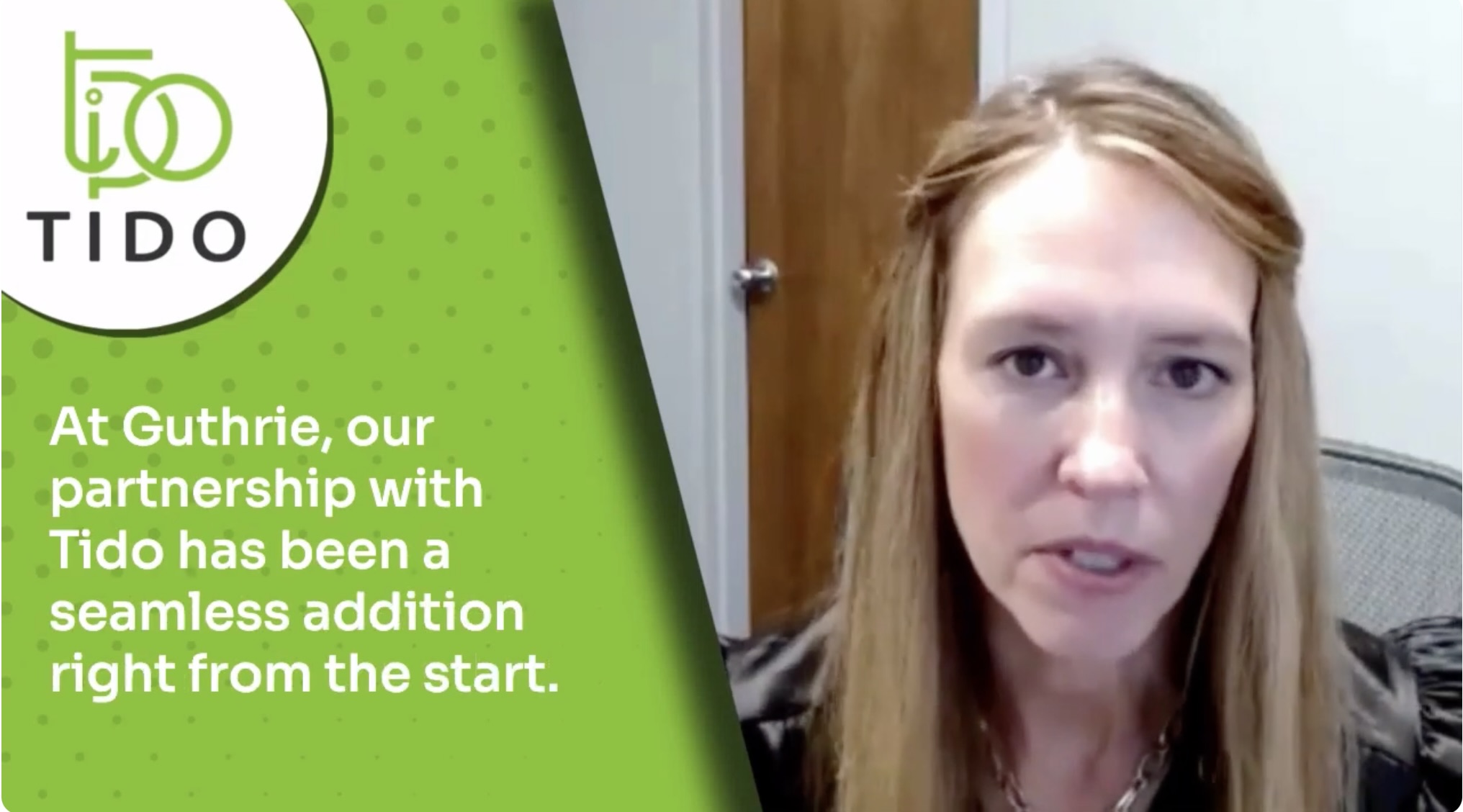
"At Guthrie, our partnership with Tido has been a seamless addition right from the start."
Terri Couts
Former SVP & Chief Digital and Information Officer
Guthrie
About Tido
Tido helps healthcare organizations ensure clinicians have access to the right data at the right time, no matter the system.
Through Tido Connect™, Tido MIDR-AI™, data migration, archive modernization, test automation, and AI-ready data foundations, Tido partners with health systems to improve reliability, reduce operational burden, increase team capacity, and lower the total cost of integration management.